Africason
Education
Culture
Black history
African history
Ancient Egyptian
African-American
African people
The lost history
Bob Marley
Kwame Nkrumah
Marcus Garvey
History of slave trade
Education and colonialism
Neo colonialism
Ancient Africa
What is Satan
The dead end of African literature
Intellectual slavery PDF
African languages
Miseducation
Dr. Amos Wilson
Kaba Hiawatha Kamene
John G. Jackson
Cheikh Anta Diop
Yosef Ben Jochannan
John H. Clarke
Ivan Van Sertima
Africa son
African son
Hello to everyone Sorry for my long absence on this blog. To those of you writing to ask why I no longer post again, that's because I fell into depression after paystack seized my earnings. I narrated my ordeal at save me from depression and possible suicide. It led to a sickness that has cost me a lot of money that I don't have. I am yet to recover from it. However, I've channeled the aftermath into research towards writing my third book. That's why I am not posting again. Should you want to support me, email: kemeticphilosophy@gmail.com I'll resume once I am fine. Thank you very much for your concern. Best regards Africason
Get link
Facebook
X
Pinterest
Email
Other Apps
How France Control the Economy of Francophone African Countries
How France Control the Economy of Francophone African Countries
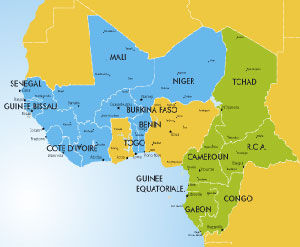
The West African Economic and Monetary Union (UEMOA) is an organization of eight West African states. It was established to promote economic integration among countries that share the Communauté Financière d'Afrique (CFA) franc as a common currency. The currency is issued by the Banque Centrale des États de l'Afrique de l'Ouest (BCEAO), located in Dakar, Senegal, for the members of the UEMOA. The union administers the West African CFA franc, now a Euro-pegged currency that is used in Benin, Burkina Faso, Côte d'Ivoire, Guinea-Bissau, Mali, Niger, Senegal and Togo.
UEMOA was created by a Treaty signed in Dakar on 10 January 1994, by the heads of state and governments of Benin, Burkina Faso, Côte d'Ivoire, Mali, Niger, Senegal, and Togo. On 2 May 1997, Guinea-Bissau became the organisation's eighth (and only non-Francophone) member state.
On 20 January 2011, the UEMOA announced that it was drafting a code that will state how member states can negotiate investments with China, as reported by the Dakar-based newspaper Sud Quotidien, citing the union's commissioner, Joseph Marie Dabré. The report said that the code would require Chinese state companies to receive approval from the Ouagadougou, Burkina Faso-based union before investing in any of the zone's eight individual states. Mining agreements between China and countries in the union would fall under the terms of the code, according to Sud Quotidien.
However, you do not have to look too far to notice that the UEMOA countries' French-controlled CFA franc is just slavery and colonialism by another name. It therefore beggars belief that the UEMOA should draft a new trade code for Chinese investments and not for the French ones in the first place!
The former president of the Ivorian National Assembly, former Finance Minister and economist, Professor Mamadou Koulibaly, labeled the French-led CFA franc arrangement as 'financially repressive, unfair and morally indefensible', in an interview with the London-based New African Magazine last year.
It has become vital today for the CFA franc to acquire its own existence, free of colonial stranglehold...After the break; the ex-CFA zone must construct its own system based on simple principles. These include: establishing direct access to international markets without having to pass through a tutor [read France]; and without a monetary guide [read France]; establish a simple fiscal system and not complicated tax codes that are incomprehensible; have flexible exchange rates vis-à-vis major currencies.
Professor Koulibaly believes that done within a democratic dispensation, free trade will do the rest for the benefit of Africa.
As it unbelievably exists today, Professor Koulibaly explained that, 'the foreign reserves of the CFA African states are deposited in the French Treasury, but no African country is capable of telling you exactly how much of this hard-earned foreign reserves belong to them. Only France has the privilege to that information'.
As Professor Koulibaly lamented, francophone Africans have been reduced to 'taxpayers for France [remember the 65% of hard currencies that the 14 CFA zone states are obliged to deposit yearly in the French Treasury]...Yet our people neither have French nationality nor access to the public goods and services made available to other French taxpayers'.
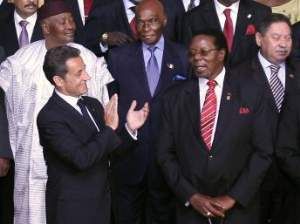
In the same New African report, Senegalese President Wade was clear and direct: 'Central bank reserves of member states must be returned to member states in one way or another. I insist on this, and particularly because we have been raising this issue for a long time'. President Wade 'deplored the fact that close to 1,500 billion CFA francs generated from the surplus of West African states' foreign reserves are placed on the foreign stock markets and out of the reach of the Africans who own the money'.
The CFA franc and its archaic arrangement with the French Treasury in Paris is indeed a slave deal. And this is how the slave deal works as elaborated by the London-based Professor Dr Gary Busch:
The French Treasury is holding billions of dollars owned by the African states of the francophone nations of West and Central Africa in its own accounts and invested in the French Bourse or Stock Exchange. The Africans deposit the equivalent of 85% of their annual reserves in these accounts as a matter of post-colonial agreements and have never been given an accounting for how much the French are holding on their behalf, in what have these funds been invested, and what profit or loss there have been.
The French have been acquiring and holding the national reserves of 14 countries since 1961. Even allowing for losses and expenditures in keeping the CFA franc viable, the French are holding about at least 400 billion dollars of African money, wholly unaccountably to the money's putative owners, the African states. Even Bernie Madoff couldn't have constructed a Ponzi scheme that large without being exposed.
This 'bargain' was made between the African former colonies and the French as part of the Pacte Coloniale which accompanied their independence and controlled through a single currency, the CFA franc. This was largely the work Jacques Foccart, the chief adviser for the government of France on African policy as well as the co-founder of the Gaullist Service d'Action Civique (SAC) in 1959 with Charles Pasqua, which specialised in covert operations in Africa.
It was Foccart 'the eminence grise' who negotiated the Pacte Coloniale with the evolving French West African states who achieved their 'flag independence' in 1960. Not really having planned for it, de Gaulle had to improvise structures for a collection of small newly independent states, each with a flag, an anthem, and a seat at the UN, but often with precious little else. It was here that Foccart came to play an essential role, that of architect of the series of Cooperation accords with each new state in the sectors of finance and economy, culture, education, and the military.
There were initially 11 countries involved: Mauritania, Senegal, Cote d'Ivoire, Dahomey (now Benin), Upper Volta (now Burkina Faso), Niger, Chad, Gabon, Central African Republic, Congo-Brazzaville, and Madagascar. Togo and Cameroon, former UN Trust Territories, were also co-opted into the club. So, too, later on, were Mali and the former Belgian territories (Ruanda-Urundi, now Rwanda and Burundi, and Congo-Kinshasa), some of the ex-Portuguese territories, and Comoros and Djibouti, which had also been under French rule for many years but became independent in the 1970s. The whole ensemble was put under a new Ministry of Cooperation, created in 1961, separate from the Ministry of Overseas Departments and Territories (known as the DOM-TOM) that had previously run them all.
The key to all this was the agreement signed between France and its newly-liberated African colonies which locked these colonies into the economic and military embrace of France. This Colonial Pact not only created the institution of the CFA franc, it created a legal mechanism under which France obtained a special place in the political and economic life of its colonies.
The Pacte Coloniale Agreement enshrined a special preference for France in the political, commercial and defense processes in the African countries. On defense it agreed two types of continuing contact. The first was the open agreement on military co-operation or Technical Military Aid (AMT) agreements, which weren't legally binding, and could be suspended according to the circumstances. They covered education, training of service personnel and African security forces. The second type, secret and binding, were defense agreements supervised and implemented by the French Ministry of Defense, which served as a legal basis for French interventions. These agreements allowed France to have pre-deployed troops in Africa; in other words, French army units present permanently and by rotation in bases and military facilities in Africa; run entirely by the French (and, incidentally, paid for by the Africans).
In summary, the colonial pact maintained the French control over the economies of the African states; it took possession of their foreign currency reserves; it controlled the strategic raw materials of the country; it stationed troops in the country with the right of free passage; it demanded that all military equipment be acquired from France; it took over the training of the police and army; it required that French businesses be allowed to maintain monopoly enterprises in key areas (water, electricity, ports, transport, energy, etc.). France not only set limits on the imports of a range of items from outside the franc zone but also set minimum quantities of imports from France. These treaties are still in force and operational today.
CFA franc countries1 How France Financially Enslaves 14 African Countries
One of the most important influences in the economic and political life of African states which were formerly French colonies is the impact of a common currency. There are actually two separate CFA francs in circulation. The first is that of the West African Economic and Monetary Union (WAEMU) which comprises eight West African countries (Benin, Burkina Faso, Guinea-Bissau, Ivory Coast, Mali, Niger, Senegal and Togo. The second is that of the Central African Economic and Monetary Community (CEMAC) which comprises six Central African countries (Cameroon, Central African Republic, Chad, Congo-Brazzaville, Equatorial Guinea and Gabon), This division corresponds to the pre-colonial AOF (Afrique Occidentale Française) and the AEF (Afrique Équatoriale Française), with the exception that Guinea-Bissau was formerly Portuguese and Equatorial Guinea Spanish).
Each of these two groups issues its own CFA franc. The WAEMU CFA franc is issued by the BCEAO and the CEMAC CFA franc is issued by the Banque des Etats de l'Afrique Centrale (BEAC). These currencies were originally both pegged at 100 CFA for each French franc but, after France joined the European Community's Euro zone at a fixed rate of 6.65957 French francs to one Euro, the CFA rate to the Euro was fixed at CFA 665,957 to each Euro, maintaining the 100 to 1 ratio. It is important to note that it is the responsibility of the French Treasury to guarantee the convertibility of the CFA to the Euro.
The monetary policy governing such a diverse aggregation of countries is uncomplicated for African Central Banks because it is, in fact, operated by the French Treasury, without reference to the central fiscal authorities of any of the WAEMU or the CEMAC. Under the terms of the agreement which set up these banks and the CFA the Central Bank of each African country is obliged to keep at least 65% of its foreign exchange reserves in an 'operations account' held at the French Treasury, as well as another 20% to cover financial liabilities.
The CFA central banks also impose a cap on credit extended to each member country equivalent to 20% of that country's public revenue in the preceding year. Even though the BEAC and the BCEAO have an overdraft facility with the French Treasury, the draw downs on those overdraft facilities are subject to the consent of the French Treasury. The final say is that of the French Treasury which has invested the foreign reserves of the African countries in its own name on the Paris Bourse.
In short, more than 80% of the foreign reserves of these African countries are deposited in the 'operations accounts' controlled by the French Treasury. The two CFA banks are African in name, but have no monetary policies of their own. The countries themselves do not know, nor are they told, how much of the pool of foreign reserves held by the French Treasury belongs to them as a group or individually. The earnings of the investment of these funds in the French Treasury pool are supposed to be added to the pool but no accounting has ever been given to either the banks or the countries of the details of any such changes. The limited group of high officials in the French Treasury who have knowledge of the amounts in the 'operations accounts', where these funds are invested; whether there is a profit on these investments; are prohibited from disclosing any of this information to the CFA banks or the central banks of the African states.
This makes it impossible for African members to regulate their own monetary policies. The most inefficient and wasteful countries are able to use the foreign reserves of the more prudent countries without any meaningful intervention by the wealthier and more successful countries. Most importantly, the French Government uses these funds on deposit in France as assets of France. The CFA franc devaluation of 50 per cent against the French franc in January 1994 was a great surprise to several of the African states and caused major problems for them.
The problems for the African states are growing. The coming crisis in the Euro, with the bailouts of Greece, Portugal and others will have a strong effect on the value of the Euro. With the CFA franc pegged to the Euro the value of the CFA will decline with it. The cost of commodities (petroleum products, foodstuffs, etc.) priced in dollars will grow to be a heavier burden on the African economies. Moreover, France itself is in deep financial trouble.
The International Monetary Fund (IMF) has warned recently that France will have to carry out more spending cuts to ensure it reaches its deficit reduction commitments amid lower-than-expected growth expectations. While France has predicted 2.25 per cent growth for 2012, the IMF has downgraded this to 1.9 per cent.
The French spent almost US$2 million a day bombing Libya; above the budgeted expenditure in its defense budget. France is very short of money. However, the cost of massacring Ivoirians, using tanks, helicopter gunships and Special Forces were offset against the Ivory Coast money it was holding so didn't add to the budgetary problems. The killing of Africans in the Ivory Coast, Cameroon, Rwanda, Chad and the Central African Republic have never been the subject of a budget request to the French defense budget as the Office of the President deducts these from the tranche at the Treasury (which is why it has never been debated in the French National Assembly). To add insult to injury the French estimated that the French business community had lost several millions of dollars in the rush to leave Abidjan in 2006 after the French Army massacred 65 unarmed civilians and wounded 1,200 others. The French demanded that the Ouattara government which they had installed paid them compensation for these putative losses. Indeed the Ouattara government paid them twice what they said they had lost in leaving.
Surely the time has come for the francophone governments to ask the French for a proper accounting of the money they are holding. Perhaps the next government in the Ivory Coast will ask the French for an accounting. Wade in Senegal has asked but was never answered. The solution seems simple. Until the French give a proper accounting for Africa's billions the African states should stop sending more to them. It is bad enough paying their overseer for the cost of his whip used to chastise them. It is wholly unreasonable to continue to do so when there is no upside, only potential losses.
Antoine Roger Lokongo is a journalist and Beijing University PhD candidate from the Democratic Republic of Congo.
French citizen explains how France exploit Francophone African countries
Role of Christian missionaries in the colonization of East Africa Christian missionaries in East Africa (1). Missionaries signed treaties which were later used by colonialists to take over colonies e.g. Tucker, a British Missionary interpreted the 1900 Buganda Agreement to the regents of Kabaka Daudi Chwa II. This led to loss of political, economic and social powers to the British protectorate government. Sir Harry John stone who signed on behalf of the British government confessed that; “I John stone shall be bound to acknowledge the assistance offered to me by the missionaries especially the CMS. Without their assistance on my side, I do not think Uganda’s chiefs would agree to the treaty which practically places their country and land in the British hands”. (From partition of Africa by Prof Sempebwa). (2). Missionaries supplied information to the colonialists which they utilized to plan how to effectively impose their colonial rule on how to crash th...
KWAME NKRUMAH: THE FATHER OF AFRICAN NATIONALISM AND THE FIRST PRESIDENT OF GHANA Celebrating our African historical personalities, discoveries, achievements and eras as proud people with rich culture, traditions and enlightenment spanning many years Osagyefo Dr Kwame Nkrumah (21 September 1909 – 27 April 1972), P.C., was the leader of Ghana and its predecessor state, the Gold Coast, from 1951 to 1966. Overseeing the nation's independence from British colonial rule in 1957, Nkrumah was the first President of Ghana and the first Prime Minister of Ghana. An influential 20th-century advocate of Pan-Africanism, he was a founding member of the Organization of African Unity and was the winner of the Lenin Peace Prize in 1963. Portrait of Kwame Nkrumah,Ghana`s first President Nkrumah was born into the Nzima ethnic group who resided in the southwester...
African American Celebrities Who Traced Their African Origin People with ancestors from all over the world live in the great nation, United States of America. Some of the Americans seek to trace their roots. For some it’s a fulfilling endeavor. Technological advancements have made it possible to achieve this endeavor successfully. Several African American celebrities have successfully found their African roots thanks to DNA databases offer by some companies which include AncestryDNA and African Ancestry. Chris Rock (Cameroon) One of the most successful comedians, Chris Rock was moved with tears when he learned about one of his ancestors, who fought for the freedom of other slaves, and became a state legislator at the age of 24. Chris Rock also found that he was descended from the Udeme people of northern Cameroon. Oprah Winfrey (Liberia, Cameroon, Zambia) Oprah Winfrey is an immensely popular name in the world. When she took a DNA test for the PBS...
Hello to everyone Sorry for my long absence on this blog. To those of you writing to ask why I no longer post again, that's because I fell into depression after paystack seized my earnings. I narrated my ordeal at save me from depression and possible suicide. It led to a sickness that has cost me a lot of money that I don't have. I am yet to recover from it. However, I've channeled the aftermath into research towards writing my third book. That's why I am not posting again. Should you want to support me, email: kemeticphilosophy@gmail.com I'll resume once I am fine. Thank you very much for your concern. Best regards Africason
Some Great African Empires Before the Coming of Europeans While Europe was experiencing its Dark Ages, a period of intellectual, cultural and economic regression from the sixth to the 13th centuries, Africans on the other hand were experiencing an almost continent-wide renaissance after the decline of the Nile Valley civilizations of Egypt and Nubia. The leading civilizations of this African rebirth were the Axum Empire, the Kingdom of Ghana, the Mali Empire, the Songhai Empire, the Ethiopian Empire, the Mossi Kingdoms and the Benin Empire. Axum Empire The Aksum or Axum Empire was an important military power and trading nation in the area that is now Eritrea and northern Ethiopia, existing from approximately 100 to 940 A.D. At its height, it was one of only four major international superpowers of its day along with Persia, Rome and China. Axum controlled northern Ethiopia, Eritrea, northern Sudan, southern Egypt, Djibouti, Western Yemen, and southern Saudi...
The True History of Slavery and Slave Acquisition in Africa By Africason (Information Europe & USA Don’t Want You to Know About Slavery) This message is for black people of non-African nationalities. I mean, black people in countries like Jamaica, USA, Haiti, Bahamas, French Guiana, Guyana, Suriname, Brazil, Mexico, Colombia, Venezuela, Ecuador, Peru, Uruguay, Bolivia, Argentina, Vanuatu, Paraguay, Grenada, Tuvalu, Solomon Islands, Chile, Peru, Panama, Belize, Costa Rica, El Salvador, Kiribati, Trinidad and Tobago, Saint Kitts and Nevis, Saint Lucia, Guatemala, Lucia, Sri Lanka, Saint Vincent and the Grenadines, Maldives, Honduras, Nicaragua, Barbados, Tonga, Panama, Samoa, Nauru, Cuba, Dominican Republic, Martinique, Puerto Rico, Papua New Guinea, Fiji, India, and also people of ALL AFRICAN NATIONALITIES. I feel a great need to write this piece to unearth the truth about information which has been deleted from the history books about slaver...
Jesus Christ was a black man- according to the bible Before I begin, let me say this article is not about religion, but about history. I am not a religious person, I am not interested in religion. It's high time black people got to begin un-learning lot of the information packed into our minds courtesy of long years of slavery and colonialism. It is time for the black race to rise and claim what is ours. History has been distorted extensively to downplay the contributions of black people to humanity. One glaring distortion is about the character called Jesus Christ in the bible, whom the ancient artists drew as a black man, ancient sculptors carved him as a black man, and even the bible itself described him as a black man in many passages. Before I go further, let me inform you that if you're a serious seeker and you're interested in digging deeper for the whole truth and nothing but the truth, no matter where it may lead to, then you'll need to first find out What...
Intellectual Slavery, The Worst Legacy of Colonialism Western in Has Fooled Me Information the west don’t want you to know (Part 1) IMPORTANT: Following many messages of gratitude that I've received from around Africa, the Americas, Asians, and other formerly colonized nations around the world who read this article, I decided to escalate the message even further. Be informed that this article has long evolved into a book and it could be downloaded for FREE. To download e-book, see details at intellectual slavery, the worst legacy of colonialism . Of course, you may read the short version below, but you'll be missing so much because the ideas were still in formation when this article was written. That's by the way. Attention: African people, Greetings my African people. This message is for independent thinking Africans. For Africans who can think for themselves. For Africans devoid of crowd mentality. This part contains revelations into why we the Afric...
The Impact of Colonialism on Africa's Economic Development The imposition of colonialism on Africa altered its history forever. African modes of thought, patterns of cultural development, and ways of life were forever impacted by the change in political structure brought about by colonialism. The African economy was significantly changed by the Atlantic slave trade through the process of imperialism and the economic policies that accompanied colonization. Prior to the "Scramble for Africa," or the official partition of Africa by the major European nations, African economies were advancing in every area, particularly in the area of trade. The aim of colonialism is to exploit the physical, human, and economic resources of an area to benefit the colonizing nation. European powers pursued this goal by encouraging the development of a commodity based trading system, a cash crop agriculture system, and by building a trade network linking the total economic output of a re...
Kwame Nkrumah’s Speech on Independence Day: 6th March, 1957 "At long last, the battle has ended! And thus Ghana, your beloved country is free forever." And yet again I want to take the opportunity to thank the chiefs and people of this country, the youth, the farmers, the women who have so nobly fought and won this battle. Also, I want to thank the valiant ex-servicemen who have so co-operated with me in this mighty task of freeing our country from foreign rule and imperialism. And as I pointed out… I made it quite clear that from now on – today – we must change our attitudes, our minds, we must realize that from now on, we are no more a colonial but a free and independent people. But also, as I pointed out, that also entails hard work. Reshaping Ghana’s destiny I am depending upon the millions of the country, and the chiefs and people, to help me to reshape the destiny of this country. We are prepared to pick it up and make ...



Comments
Post a Comment